
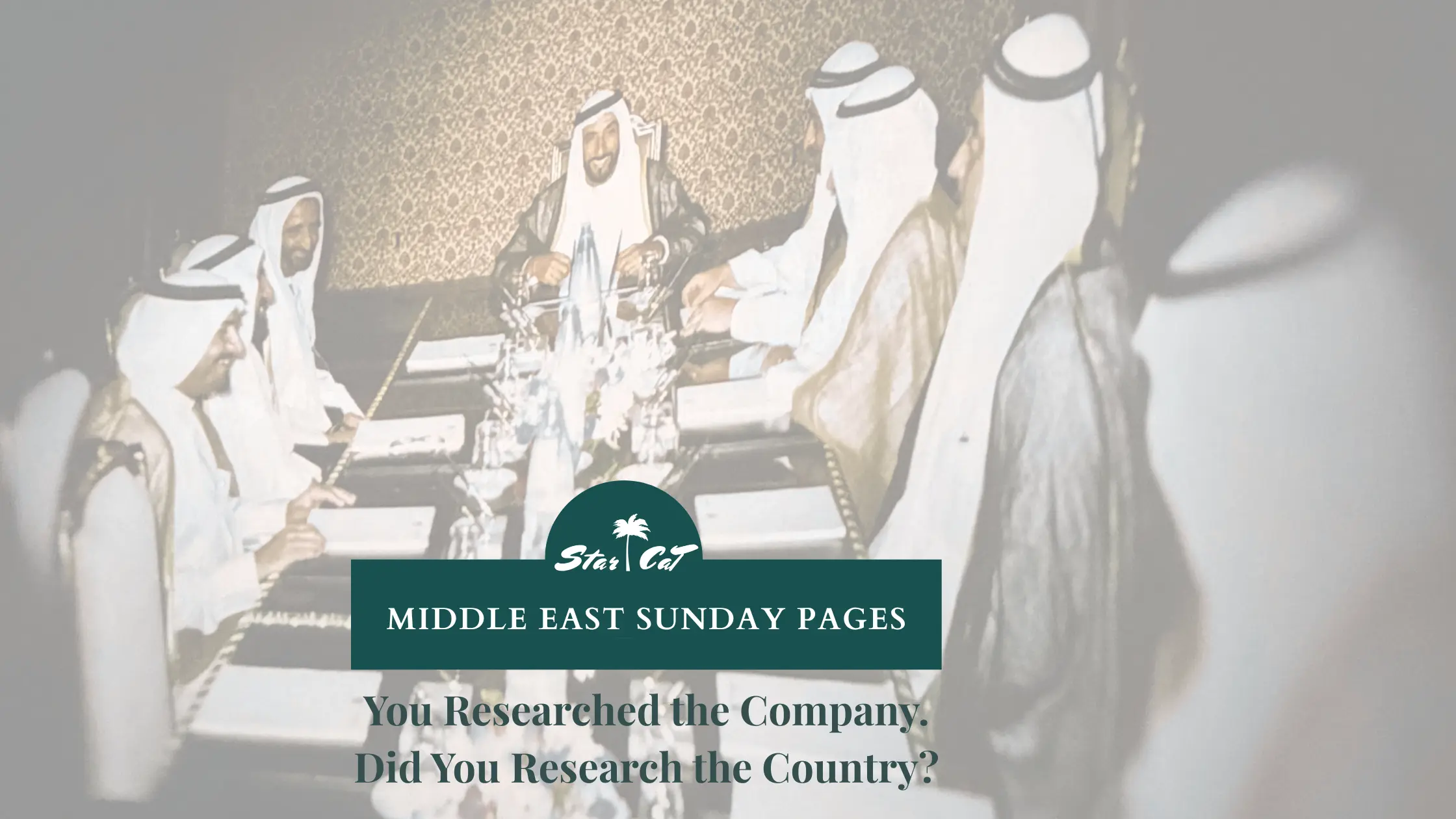
How to Prepare for a Meeting in Saudi Arabia — the 15 Minutes That Decide the Room
The most expensive mistake I see Western companies make in the Gulf has nothing to do with what they say in the meeting. Three companies flew into Riyadh last month. All three had excellent products. All three had researched the client. Only one had researched Saudi Arabia. Guess which one left with the relationship. The difference was not the product. It was what they knew before they walked in.
I get asked, almost every week, what separates the companies that win business in Saudi Arabia, the UAE and Qatar from the ones that quietly stall. People expect me to talk about dress codes, business cards, whether to use WhatsApp instead of email. Those things exist. They are also not the reason a company loses a mandate.
The reason is simpler, and more costly. Most companies prepare for a Gulf meeting the same way they would prepare for one in Frankfurt or Chicago. They read the company website. They check the executives on LinkedIn. They rehearse the deck. Then they arrive believing they are ready.
They researched the company. They never researched the country.
In the Gulf, those are two different jobs — and the second one is where the deal is actually won or lost.
The meeting starts before you are in the room
Every conversation in Saudi Arabia, the UAE, Qatar, Oman, Bahrain and Kuwait happens inside a national context that is moving fast and moving all the time. A cabinet reshuffle. A new Vision 2030 target. A sovereign wealth allocation. A period of national mourning. A leadership speech that reset the priorities of an entire ministry the week before you flew in.
The people across the table live inside that context. They are not going to test you on it. But they will notice, in the first few minutes, whether you arrived from inside their world or from outside it. That noticing is not a formality. It is the first data point they have on whether you are someone worth building something with — and in the Gulf, where one project becomes an introduction and an introduction becomes a decade of work, that first data point compounds.
Two recent examples show how quietly the ground moves.
Last month the UAE marked Union Pledge Day, on 18 July. Most people outside the region had never heard of it. Inside the UAE it carries real weight — it marks the day in 1971 when Sheikh Zayed and the founding rulers signed the declaration of union and named the country. It is not even a public holiday, which is exactly why an outsider sails past it and an Emirati does not. You could hold a perfectly good meeting without knowing it existed. But knowing — being able to acknowledge it without being prompted — changes the temperature of the room in a way no slide ever will.
The second example was larger, and got past a great many international businesses. On 12 July, Qatar announced the death of Sheikh Hamad bin Khalifa Al Thani, the Father Emir — the man who rebuilt modern Qatar, founded Al Jazeera, won the 2022 World Cup bid, and handed power to his son in one of the region’s rare voluntary successions. To much of the world it was a headline that scrolled past by lunchtime. Inside Qatar, national attention shifted entirely. Condolences mattered. Schedules moved. The mood, the priorities, the appetite for new commercial conversations — all of it changed for a period.
A company that saw a headline and carried on as normal was, without realising it, walking into a different country than the one it had prepared for.
Imagine spending six months getting a meeting with a Saudi CEO. Flying 3,000 miles. Perfecting your presentation. Only to discover everyone in the room is discussing something you have never even heard of.
Information is everywhere. Intelligence is rare.
None of this is secret. The news is not hard to find. Bloomberg, Reuters, the Financial Times and a thousand newsletters will all tell you what happened.
We no longer have an information problem. We have a filtering problem. The internet gives everyone access to the same headlines. Competitive advantage no longer comes from finding information. It comes from interpreting it faster and better than everyone else.
What none of them tells you is the only thing that matters to you: so what?
What does the passing of the Father Emir mean for the proposal I was about to send to a Doha family office next Tuesday? Should I wait? Should I lead with condolences, and if so, how? Does a new AI mandate in Abu Dhabi make my product more relevant this quarter, or less? Is this the week to push, or the week to listen?
Those answers do not come out of a search engine. They come from having watched the pattern play out enough times to know what it means. That gap — between the information everyone has and the intelligence almost nobody does — is the whole game. The companies that win in the Gulf are not better at selling. They are better informed, earlier, about what the information actually means for them.


The five layers of Gulf intelligence
After 25 years working across the region, I prepare for anything that matters through five layers. It is a simple habit, and it is the difference between arriving tactical and arriving strategic.
- Current affairs. What has actually happened this week — not globally, but in that specific country. Saudi Arabia, the UAE and Qatar are not one market, and this week’s news in Riyadh is not this week’s news in Doha.
- Commercial context. Why does that development matter to business? Which sectors does it move? Who just became more important, and who just became harder to reach?
- Relationship intelligence. How does it change the conversation you are about to have? The timing, the mood, what to raise and what to leave. This is the layer almost everyone skips, and it is the one that decides the meeting.
- Practical action. What do you actually do differently as a result? Delay the follow-up. Open with an acknowledgement. Ask a different question. Listen more than you planned to.
- Long-term direction. How does this connect to where the country is going — Vision 2030, economic diversification, the national AI strategies now running top-down across the GCC? This layer is what turns a vendor into a partner, because it shows you understand not just the meeting but the mission behind it.
Run those five layers before any serious Gulf conversation and you will walk in ahead of almost everyone you are competing with.
I have been there.
Twenty years ago, I made exactly this mistake. I walked into a meeting in Saudi Arabia determined to be efficient. Being German, I thought getting straight to business showed respect for people’s time. So I opened my laptop and launched into the presentation. My client smiled politely. Then spent the next twenty minutes talking about everything except the presentation. This was the day I realised something that completely changed how I work.
In the Gulf, relationships come before business. The meeting starts long before anyone opens a laptop.
Sometimes the cost is not losing today’s meeting. It is never being invited back.
Where AI actually helps — and where it quietly fails you
Artificial intelligence has changed how I work, and I use it every day. ChatGPT, Claude and Gemini will summarise a ministerial speech, compare this year’s budget priorities to last year’s, translate a press release, draft the questions worth asking, and surface patterns across a stack of announcements in minutes that used to take me the better part of a week.
They are extraordinary tools. But there is a trap inside them that catches most people, and it is worth naming plainly.
AI can only answer the question you know to ask.
If you have never heard of Union Pledge Day, you will not ask about it — and the model will not volunteer it. If you did not notice a quiet ministerial appointment, AI will not tell you why it matters, because you never raised it. The machine amplifies your awareness. It does not create it. Feed it shallow prompts built on shallow knowledge and it will hand you a confident, fluent, useless answer — the kind a Gulf client sees through in the first five minutes.
This is why the future in this region does not belong to the people who simply use AI. Every competitor will have the same tools by Christmas. It belongs to the people who combine AI with genuine regional knowledge — who know enough to ask the right question, and then use the machine to answer it faster and better than anyone else in the room.


What to do before your next Gulf meeting
Here is what you can start doing on Monday, without buying anything from me.
Build one weekly habit. Thirty minutes, same time each week. First, find out what actually happened in the specific country you care about. Second, ask what it means commercially. Third, put both into an AI tool and ask how those developments might affect your particular client, sector or meeting. Write down one action.
Do that every week and it compounds. Small signals become sharper conversations. Sharper conversations become stronger relationships. Relationships become the opportunities your competitors never even hear about, because they were still reading the headline while you were already in the room.
That is the what, and it is genuinely most of the battle. What to do when the signals get subtle — when the timing is delicate, the mood has shifted, and the difference between the right move and the wrong one is measured in millions — is the deeper level. That is the part built on 25 years of watching it play out, and it is what I have tried to put within reach of people who do not have 25 years to spare.
Relationships are built in meetings. Competitive advantage is built before them.
The system I wish I’d had 20 years ago
For years, people asked me the same question: how do you always seem to know what is going on?
The honest answer was never that I read more than everyone else. It was that I had built a system for paying attention — and eventually I realised other people needed that system far more than they needed another consultant flying in for a day.
If you have read this far, you probably don’t need another newsletter. You need a better intelligence system.
This is why The Gulf Desk exists. Every Monday, I do the first four layers of Gulf Intelligence for you, so you can spend less time chasing headlines and more time building relationships if you are a founder, business development executive, hotel leader, investor or adviser. Not hours of newspapers every morning. One briefing, read in the time it takes to drink a coffee, that means you never walk in as the least-informed person at the table.
The Boardroom Edition is the full weekly briefing, and it includes the Gulf calendar that keeps your timing right — every national day, mourning period and trade event that decides whether your outreach lands or dies.
If you want to go one level further — to build the whole system yourself, to use AI to find the right decision-makers and prepare for meetings in minutes rather than days — that is what I teach in my September masterclass. Because intelligence without execution changes nothing. Knowing something matters. Knowing how to act on it, faster than the person across town, is what actually wins the business.
The companies that succeed in the Gulf do not have access to secret information. They have simply built better systems for noticing what everyone else overlooks.
Every Monday, I share mine.
Frequently asked questions
How do you prepare for a business meeting in Saudi Arabia? Research the country, not only the company. Beyond the client’s website and LinkedIn, understand what is happening nationally that week — government announcements, Vision 2030 priorities, national occasions, the current commercial mood — and work out what it means for your specific meeting. The company research tells you who you are meeting; the national context tells you how to meet them well.
What is the biggest mistake Western companies make in the Gulf? Arriving with yesterday’s information. Most companies prepare thoroughly for the meeting itself and almost not at all for the national context surrounding it. In Saudi Arabia, the UAE and Qatar, that context — timing, mood, national priorities — often decides the outcome before anyone opens a laptop.
Can AI help you prepare for meetings in the Gulf? Yes, considerably — for summarising speeches, comparing announcements, translating, drafting questions and spotting patterns. But AI only answers the questions you know to ask. Without genuine regional knowledge you will not know what to prompt it about, and it will return confident, generic answers a Gulf client sees through immediately. AI amplifies expertise; it does not replace it.
Who is Corina Goetz? Corina Goetz is the founder of Star-CaT and the author of The Gulf Desk. She has spent more than 25 years advising governments, luxury hospitality brands and international businesses on building relationships and winning work across Saudi Arabia, the UAE, Qatar, Oman, Bahrain and Kuwait, specialising in Gulf strategy, cultural intelligence and AI-enabled business development.

Corina is a Middle East Strategist and Founder of Star-CaT. Over the past 20 years, she's helped thousands of clients overcome their anxieties and misconceptions about the Gulf region, and take advantage of the incredible opportunities available to them.

Related Posts
This Post Has 0 Comments