The Business Calendar of the Gulf: Every Key Date Western Professionals Should Know
Picture this. You have booked your flights to Dubai or Riyadh. The proposal is polished. The meeting is confirmed. You land, jet-lagged but ready, and the office is half empty. Your contact is in — but distracted, exhausted, and very much not in deal-closing mode. Nobody told you it was the final week of Ramadan.
This happens. More than you would think.
The Gulf runs on a completely different calendar to the West. Not just a different schedule — a different logic. Religious observance, national pride, Islamic timekeeping, and a business culture that actually shuts down during its major holidays (unlike the West, where deals still happen over Christmas). If you do not know the rhythm, you will waste time, money, and credibility on trips that should never have been booked.
Here is everything you need to know.
Why the Gulf Calendar Is Not Your Calendar
Let’s start with the obvious thing most Westerners miss: the Islamic calendar is lunar. That means it is approximately 11 days shorter than the Gregorian calendar each year. Every major religious date — Ramadan, both Eids, Islamic New Year, the Prophet’s Birthday — shifts earlier each year by around 11 days.
There is no fixed date. No “same time next year.” You have to check, every single year. (And this what so many companies miss)
The second thing: the Gulf working week is not the same everywhere. Saudi Arabia, Qatar, Kuwait, Bahrain, and Oman all observe Friday–Saturday as the weekend. Sunday is a working day. The UAE moved its public sector to Monday–Friday in January 2022 — but most of the private sector still operates on a Sunday–Thursday or hybrid basis, and many regional offices across the GCC have not followed suit.
If you are scheduling calls from London on a Friday afternoon assuming everyone in Riyadh has knocked off early for the weekend — they have not. Friday is the weekend. They are at Friday prayers.
Get these two fundamentals wrong and everything else falls apart.
Ramadan: The Month That Changes Everything
Ramadan is the single most important thing to understand about doing business in the Gulf. It is a month of fasting from dawn to sunset — no food, no water, no smoking. But more than that, it is a month of reduced pace, heightened spiritual focus, and fundamentally different working hours.
In most GCC countries, the working day is legally shortened during Ramadan. Many offices operate from around 9am to 2pm or 3pm. Decision-making slows. Executives are managing energy levels as well as business. Afternoons are quieter. Evenings, after Iftar (the fast-breaking meal at sunset), often become more socially active — but that does not mean business-ready.
What you must never do during Ramadan:
- Eat, drink, or chew gum in public or in front of fasting colleagues — even water
- Book a working lunch or dinner meeting during daylight hours expecting your host to eat with you
- Assume reduced hours means reduced seriousness — it does not
- Dismiss the shortened day as “nothing getting done” and fail to follow up appropriately
Ramadan is not a period to avoid entirely. Senior decisions still get made. Relationships still get built. But you need to approach it differently — with patience, cultural sensitivity, and a realistic timeline.
If you want to understand exactly how to navigate Ramadan professionally — from what to say when someone invites you to Iftar to how to handle contract negotiations during this period — this is covered in depth inside the Gulf Etiquette Success Playbook.
Eid Al-Fitr: Do Not Even Try to Do Business
Eid Al-Fitr marks the end of Ramadan. It is a public holiday across all six GCC nations — and in practice, it often stretches longer than the official duration through annual leave taken around it.
This is non-negotiable time off. Businesses close. Government offices close. People travel to be with family. Anyone who does answer their phone or email is doing you a favour and is unlikely to be giving your proposal their full attention.
Rule of thumb: build in a buffer of at least three to four working days either side of Eid Al-Fitr before expecting normal business activity to resume.
Eid Al-Adha: The One Westerners Forget
Eid Al-Adha — the Festival of Sacrifice — is in many ways the more significant of the two Eids. It coincides with the Hajj pilgrimage to Makkah. Many Gulf nationals travel to Makkah; others visit family. It is an extended public holiday across the region.
Eid Al-Adha tends to get less attention in Western business circles than Eid Al-Fitr, precisely because it does not follow a visible month like Ramadan. But the business impact is just as real — often more so, because senior decision-makers are frequently out of the country.
If you have major proposals or deal timelines running through early June 2026, adjust now.
Other Islamic Dates That Affect Business
Islamic New Year (Muharram / Al-Hijri New Year)
Public holiday across most GCC states. A single day in most countries, but can affect government response times for a few days around it.
Mawlid Al-Nabawi (Prophet Muhammad’s Birthday)
Observed as a public holiday in most GCC countries. Again, a single day — but worth noting if you have contract deadlines or government approvals that you are waiting for.
Important National Holidays: Country by Country
This is where most Western professionals are completely in the dark. Each Gulf nation has its own national day — and some have more than one. These are points of enormous national pride. They are not flexible.
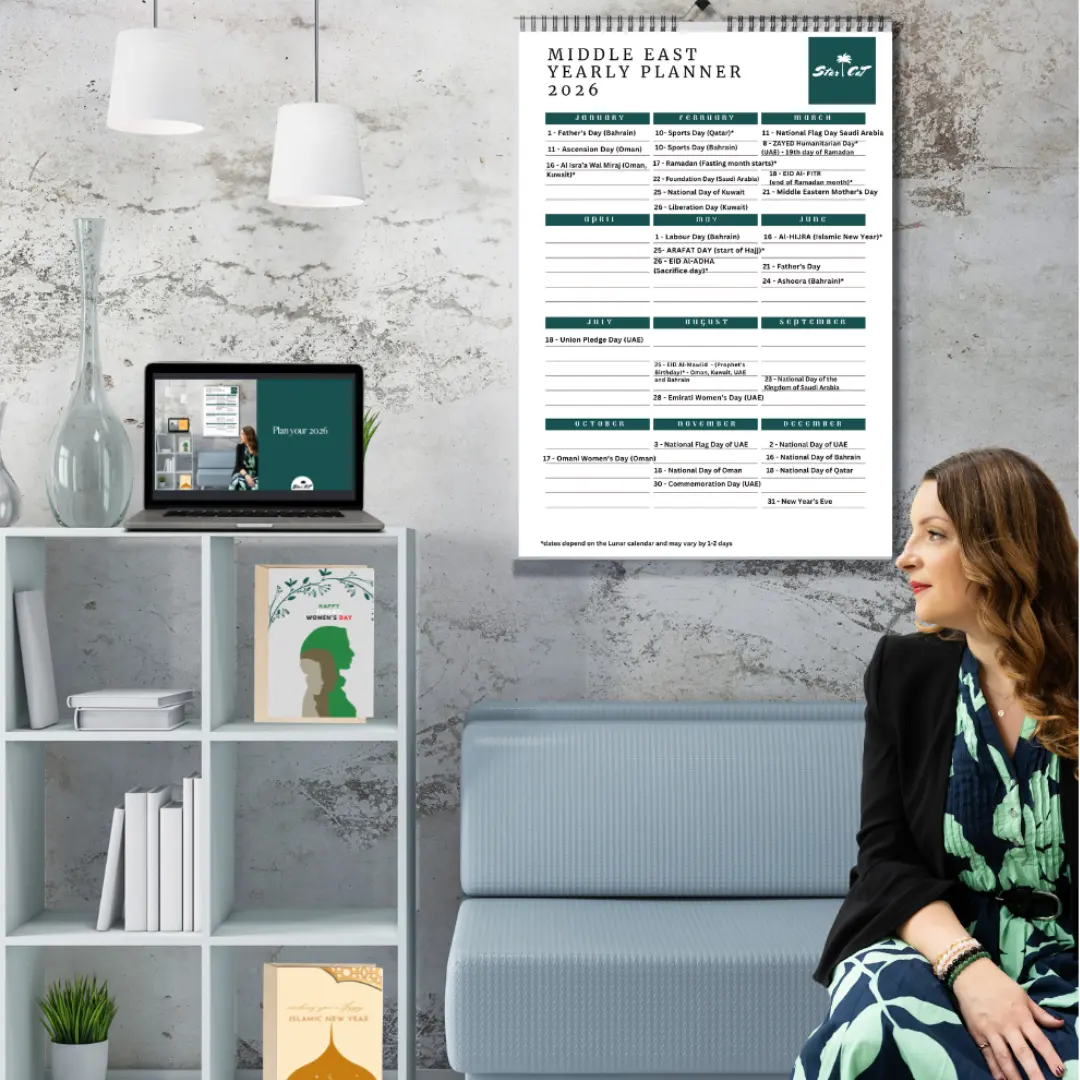
UAE National Day — 2 December Two days. The UAE celebrates its union of Emirates with significant national events, school closures, and office shutdowns. December is actually an extremely busy period in the UAE — GITEX has just wrapped, the weather is perfect, business is buzzing — but these two days are a complete stop.
Saudi National Day — 23 September One day, but Saudi National Day has grown significantly in its celebration profile under Vision 2030. Expect a full day closure and, increasingly, a festive atmosphere in the days around it.
Kuwait National Day & Liberation Day — 25–26 February Two consecutive national holidays. Kuwait essentially shuts down for two days in late February every year.
Qatar National Day — 18 December Full public holiday. Given Qatar’s international profile since the 2022 World Cup, this is increasingly on the radar — but the business shutdown is real.
Bahrain National Day — 16 December Two days of public holiday, often with celebrations extending into the week.
Oman National Day — 18 November Full public holiday marking the birthday of the late Sultan Qaboos (now observed in honour of national heritage and the current leadership).
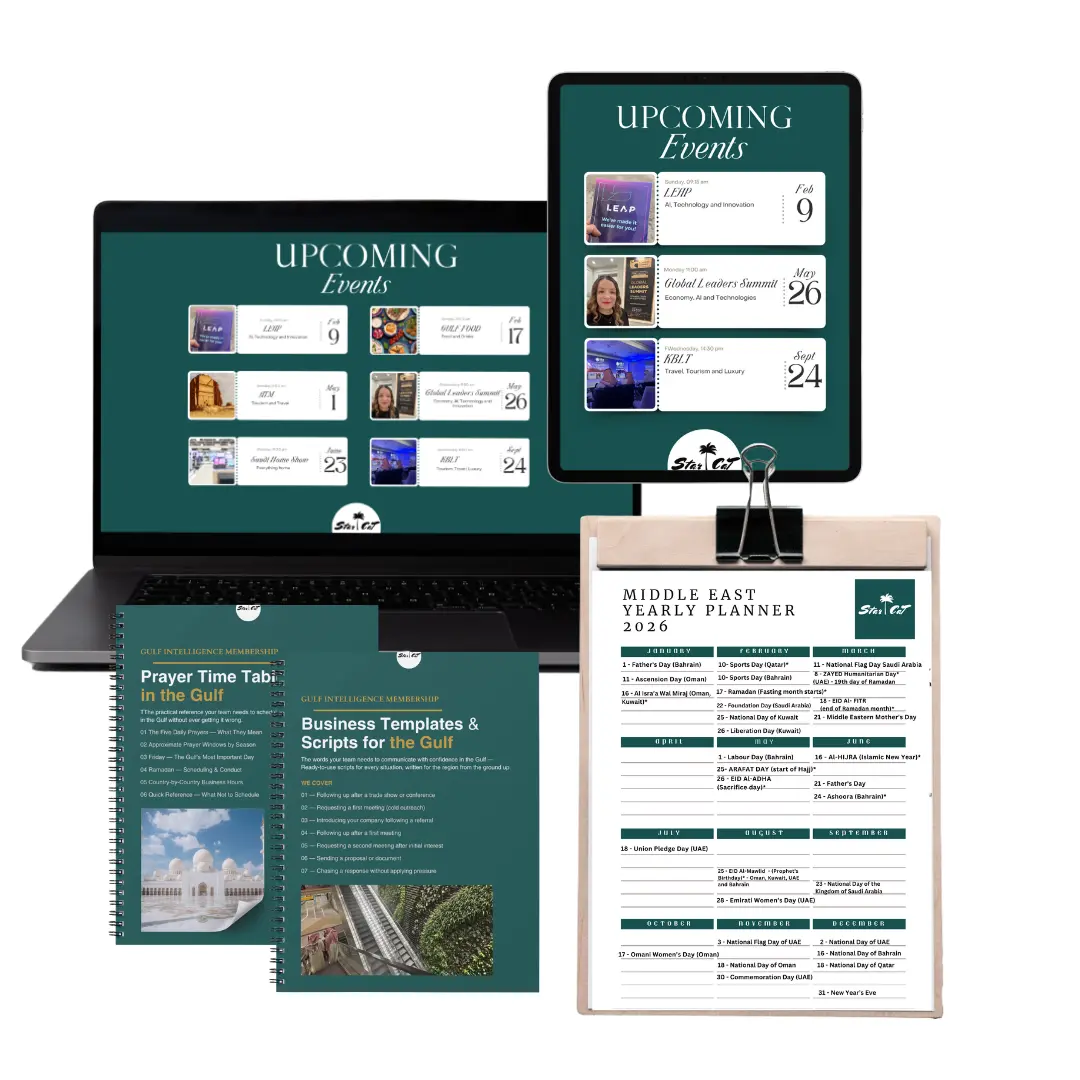
For a current, fully updated view of all these dates — including trade show and events calendar, business travel briefings, and email scripts for navigating sensitive periods — the Gulf Intelligence Membership gives you a monthly digest built specifically for Western professionals operating in the region. At £37 per month, it is genuinely the most practical investment you can make if the Gulf is a regular part of your business year.
The Summer Slowdown: July and August
This one does not appear in any official calendar. But it is real.
July and August in the Gulf are brutally hot — temperatures routinely exceeding 45°C. Gulf nationals take extended leave, often travelling abroad. Government ministries operate on skeleton staffing. Private sector decision-makers slow down significantly.
If you need a government approval, a regulatory response, or a senior executive decision in July or August, build in significantly more time than usual. The documents will get processed. Just not fast.
This is particularly important in Saudi Arabia, where government processes can already move slowly — add summer attrition and you need to be planning months ahead.
Trade Show Season: When the Gulf Comes to Life
Alongside the cultural and religious calendar, there is a trade show and conference calendar that shapes the entire Gulf business year. These events are genuine deal-making environments — not just exhibitions.
Key dates to know:
- Arab Health (Dubai) — The world’s second-largest healthcare trade event. If you’re in healthcare, pharma, or medtech, this is non-negotiable.
- Gulfood (Dubai) — The world’s largest annual food and beverage trade show. Critical for F&B, FMCG, and hospitality.
- GITEX Global (Dubai) — The region’s premier technology event. Government delegations, major deals, serious investment conversations.
- ADIPEC (Abu Dhabi) — One of the world’s largest energy events. Essential for oil and gas, energy transition, and related sectors.
- The Big 5 (Dubai) — The Middle East’s leading construction and building materials event.
These are periods of intense business activity. Hotels fill up months in advance. Getting a meeting during GITEX week requires planning in October, not the week before.
The Gulf Intelligence Membership includes the full 2026 Middle East Trade Show and Events Calendar, updated regularly — so you always know what is coming and can plan your visits around maximum business opportunity.
Using the Calendar Strategically
Here is the shift in mindset that separates the professionals who consistently do well in the Gulf from those who keep running into walls.
The calendar is not an obstacle. It is intelligence.
Knowing that Eid Al-Adha falls in early June means you close your proposal in May — not mid-June when everyone has only just returned. Knowing that ADIPEC is in November means you book your Abu Dhabi hotel in August. Knowing that Saudi Founding Day sits in late February means your Q1 Saudi timeline accounts for a short month that just got shorter.
The professionals who complain that “business is slow” or “they never respond” are the ones who have not mapped the calendar. The ones who close deals are already three months ahead.
If you are serious about building a Gulf business presence, the Gulf Etiquette Success Playbook gives you the complete cultural framework — the etiquette, the communication norms, the relationship-building logic — that sits alongside this calendar intelligence.
And if you have a specific, time-sensitive challenge right now — a trip coming up, a deal at a critical stage, a relationship that needs managing carefully — a Power Hour with Corina gives you direct, tailored advice based on 20+ years of Gulf business experience.
The Bottom Line
The Gulf is a high-opportunity, high-context business environment. The professionals who succeed there are not necessarily the ones with the biggest budgets or the most polished pitches. They are the ones who understand the rhythm — and respect it.
Map the calendar before you book the flights.
Start with the Gulf Intelligence Membership — £37/month, cancel anytime — and get the 2026/27 trade show and events calendar, monthly business briefings, and the cultural cheat sheets that mean you always know what is happening in the region before it catches you out.

Corina Goetz is a Saudi and Gulf business expert and the founder of Star-CaT, advising Western companies in Saudi Arabia, the UAE and Qatar. For more than 20 years she has worked with Gulf royal households, ministries and family offices, and helped Western businesses build trust in Saudi Arabia and the GCC. She writes a weekly Middle East blog and the Gulf Desk. If you have a live Saudi deal, book a private consultation.

Related Posts
This Post Has 0 Comments